Tripo AI Tokyo Workshop Held in Shinjuku: Translating Fukushima’s Local Culture into 3D Experiences, Starting from a Single Image
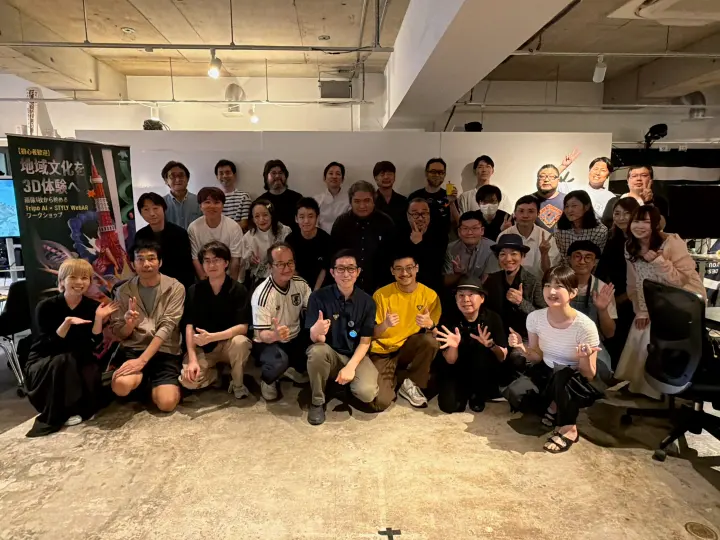
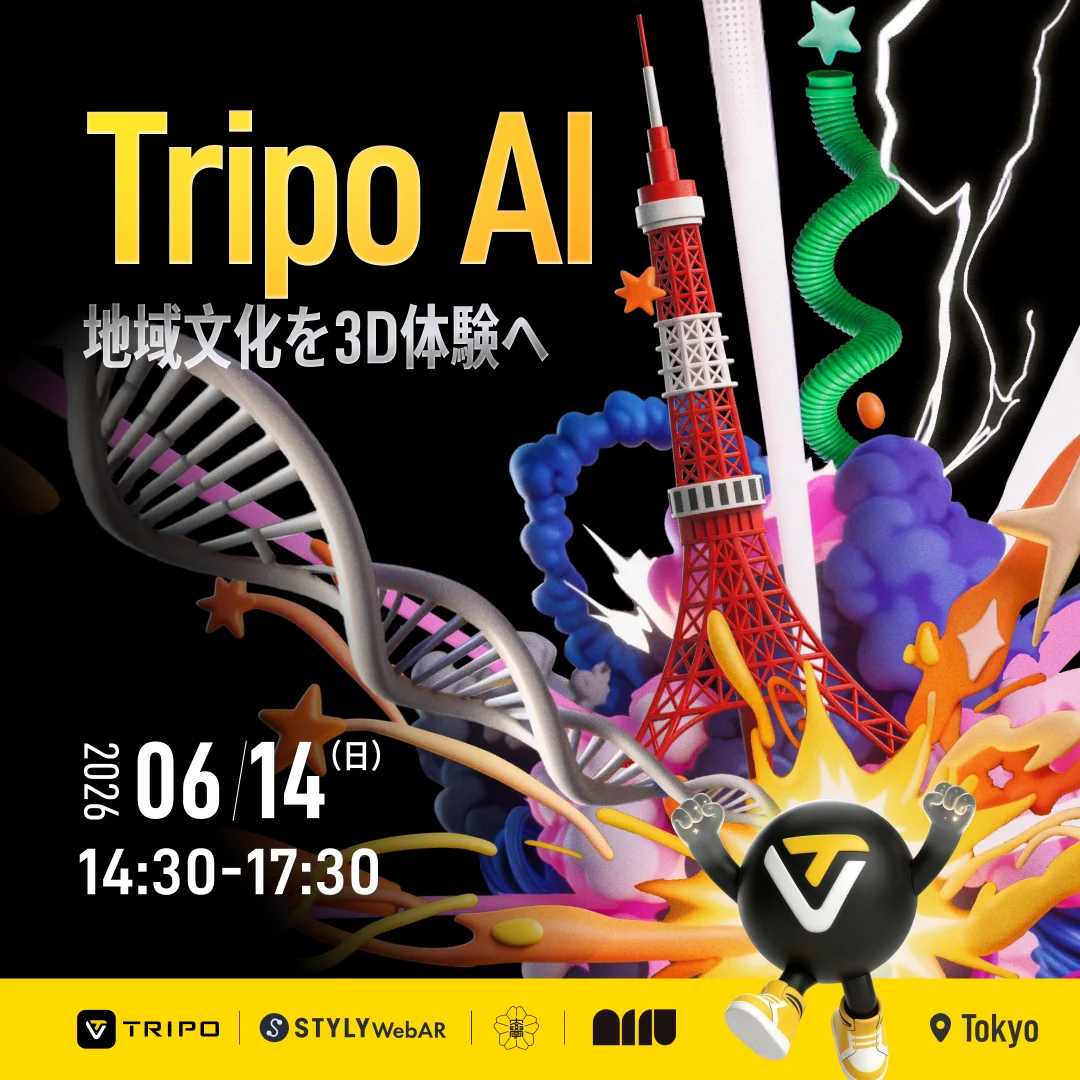
On June 14, 2026, the Tripo AI Tokyo Workshop | Beginner-Friendly: Starting with a Single Image and Translating Local Culture into a 3D Experience was held in Shinjuku, Tokyo.
Hosted by Tripo AI, the workshop was co-organized with STYLY WebAR and the Institute for Art Workshop Design Projects at Jissen Women’s University, with participation from Art Marketing Japan.
The workshop brought together around 40 participants from education, art, gaming, XR, digital creation, and related fields. Together, they experienced the complete workflow of generating a 3D model from an image and bringing it into the real world through STYLY WebAR.
Tripo Ecosystem Lead Josephine Yi, Tripo Education Ecosystem Lead Chris Li, Professor Hajime Shimoyama, Director of the Institute for Art Workshop Design Projects at Jissen Women’s University, Saito Eishi and Umi from the STYLY WebAR team, and Sakuyama from Art Marketing Japan all joined the event.
The program combined project presentations, product demonstrations, hands-on creation, participant showcases, and open networking. Participants remained actively involved from the 2:30 p.m. opening session through the end of the workshop, with the final showcase becoming one of the most inspiring moments of the day.
Starting 3D Creation with a Single Image
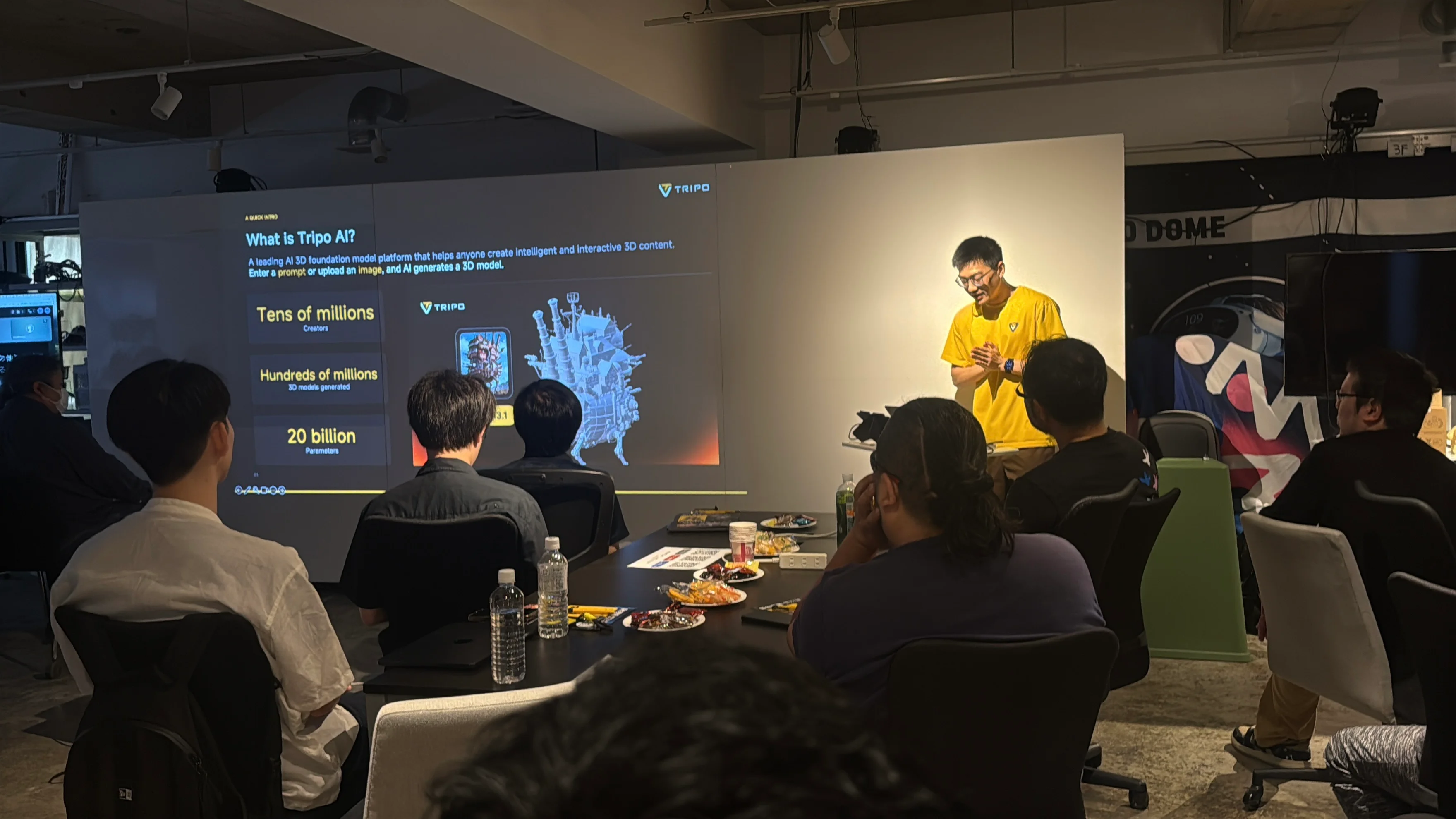
The workshop began with an introduction from the Tripo AI team, covering recent product updates, AI-powered 3D generation capabilities, and the potential applications of Tripo across creator communities, education, and cultural projects.
In a traditional 3D production workflow, creating a usable model often requires multiple stages, including modeling, sculpting, retopology, UV mapping, texturing, rigging, and format conversion.
For students, educators, artists, and participants in local cultural projects, this process creates a significant technical barrier. Many creative ideas are blocked by complex software and production requirements before they ever reach a 3D environment.
Tripo AI aims to make the starting point of 3D creation more accessible.
By uploading an image or entering a text prompt, creators can quickly generate a 3D model and continue using it in STYLY WebAR, games, XR projects, 3D printing, exhibitions, and educational activities.
During the Tokyo workshop, many participants used H3.1 in Tripo Studio to generate highly detailed 3D models. They then imported their models into STYLY WebAR and placed them in real-world environments for viewing and sharing.
H3.1 is designed for high visual quality and detailed model generation, making it particularly suitable for creative projects that require stronger structural definition, richer textures, and more refined visual presentation.
For the artists, students, and 3D printing creators who attended the workshop, this meant that illustrations, handmade objects, character concepts, and personal ideas could be transformed into spatial assets more quickly and carried into further production workflows.
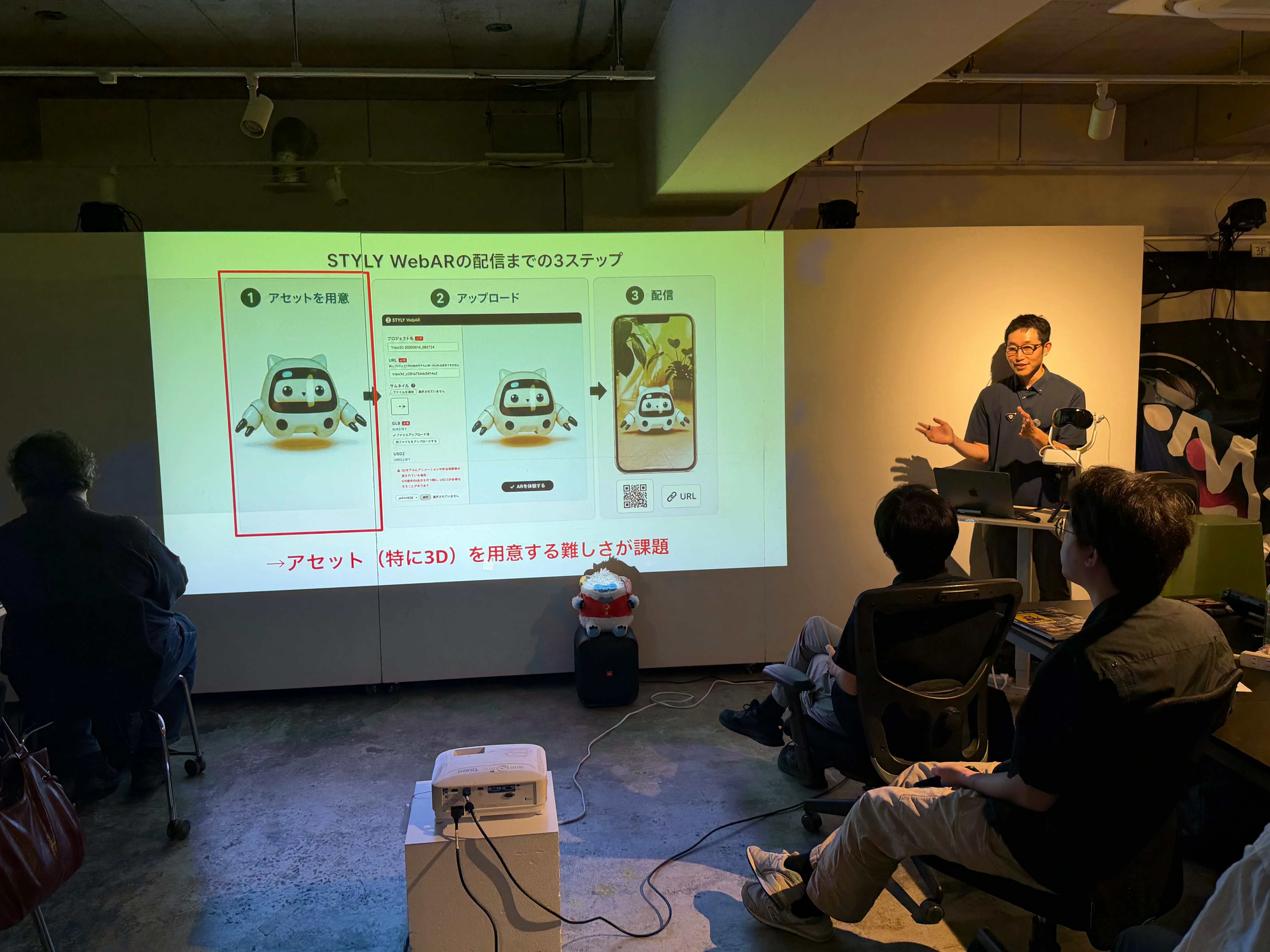
The workshop also featured a demonstration of a workflow built with the Tripo API and STYLY WebAR. Using Apple Vision Pro, the team presented the complete process of uploading an image, generating a 3D model with AI, and experiencing the result in AR.
For many participants, this moved AI-generated 3D beyond a model preview on a screen. The generated content could now be placed, moved, experienced, and shared within physical space.
From Soma, Fukushima: Bringing Local Culture into a New Creative Setting
An important part of the workshop’s background came from the long-term Fukushima Soma project led by Professor Hajime Shimoyama and the Institute for Art Workshop Design Projects at Jissen Women’s University.
Soma is a coastal city in Fukushima Prefecture with historical and cultural resources that include the Nakamura Castle Ruins and the Shōhō castle map.
Working with these local memories, Professor Shimoyama and his team developed an approach centered on the concept of “cultural translation.” The goal is to transform historical cultural resources into forms that people today can participate in, understand, and continue to develop through their own creative work.
The 2025 project began with the theme of the “castle.”
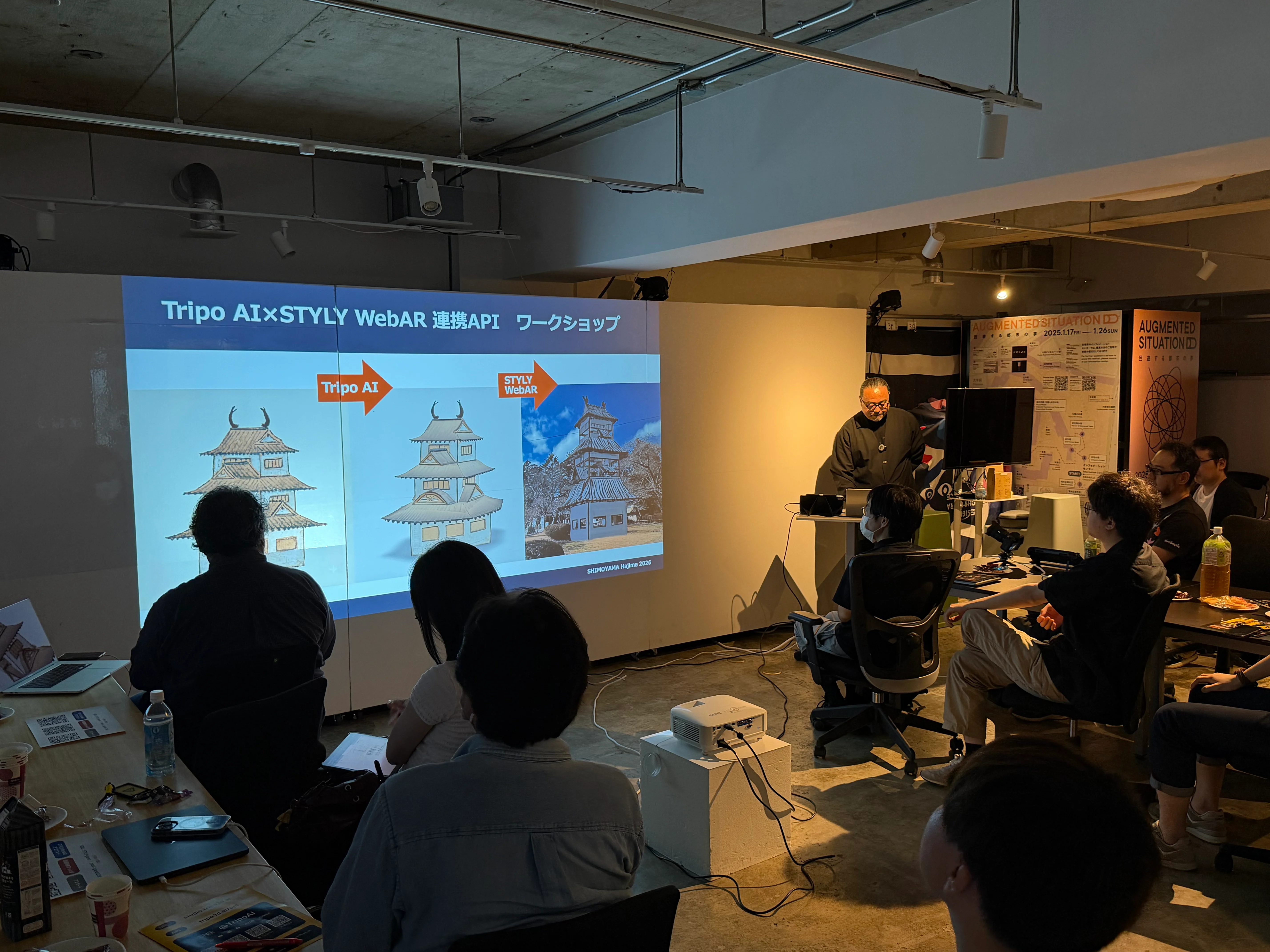
Participants created their own castles using paper and handmade materials. They uploaded images of their work to Tripo AI, generated 3D models, and then used STYLY WebAR to place those models within the real-world environment of Nakamura Castle Ruins Park.
Handcrafting, AI-powered 3D generation, and STYLY WebAR were connected within a single day. The objects created by participants appeared again within the historical location that had inspired the project.
In 2026, the project is continuing with the theme of the “gate.”
The team plans to develop new creative and educational activities around the castle gates and keep depicted in the Shōhō castle map. The project will also be connected to integrated inquiry-based learning for local high school students in Soma.
Students will read historical maps, study the locations, forms, and meanings of the castle gates, and then use AI 3D generation and STYLY WebAR to transform these cultural references into spatial experiences.
During the Tokyo workshop, Professor Shimoyama introduced the background of Fukushima, Soma, Nakamura Castle, and the project’s cultural translation methodology.
His presentation showed participants that the value of AI 3D in cultural projects extends beyond production efficiency. It can also create new forms of expression for local culture, education, and public participation.
STYLY WebAR: Bringing 3D Models into the Real World
After a 3D model is generated with Tripo AI, STYLY WebAR plays a key role in bringing that model into physical space.
During the workshop, the STYLY WebAR team introduced its creator ecosystem, browser-based AR capabilities, and related projects across global creator communities, XR experiences, and brand collaborations.
The team shared that STYLY’s creator community now spans 39 countries, with more than 100,000 creators and over 5 million app downloads.
Through STYLY WebAR, participants can turn their 3D models into AR experiences that open directly in a mobile browser, without requiring a complex development process.
Models can be placed on a table, inside an event venue, or within an urban environment. They can also become part of exhibitions, classrooms, public art projects, and other spatial experiences.
For the Fukushima Soma project, STYLY WebAR allows local culture to move beyond documents, verbal explanations, and static displays.
Participants can use their phones to place their generated 3D works back into the real world and observe familiar environments from a new perspective.
Through this experience, everyday spaces can be viewed in new ways, while local memories gain new paths for discovery and participation.
Hands-on Creation: From a Violin and Album Artwork to a Hand-Painted Zombie Badge
The most dynamic part of the workshop came during the hands-on creation session and the final participant showcase.
Around 40 participants remained engaged through the end of the event. The group included teachers, students, artists, game creators, video creators, existing Tripo users, and professionals working in XR.
Many participants arrived with their own images, character concepts, illustrations, and creative ideas. They used Tripo to generate 3D models and then explored how those models appeared when placed in the real world through STYLY WebAR.
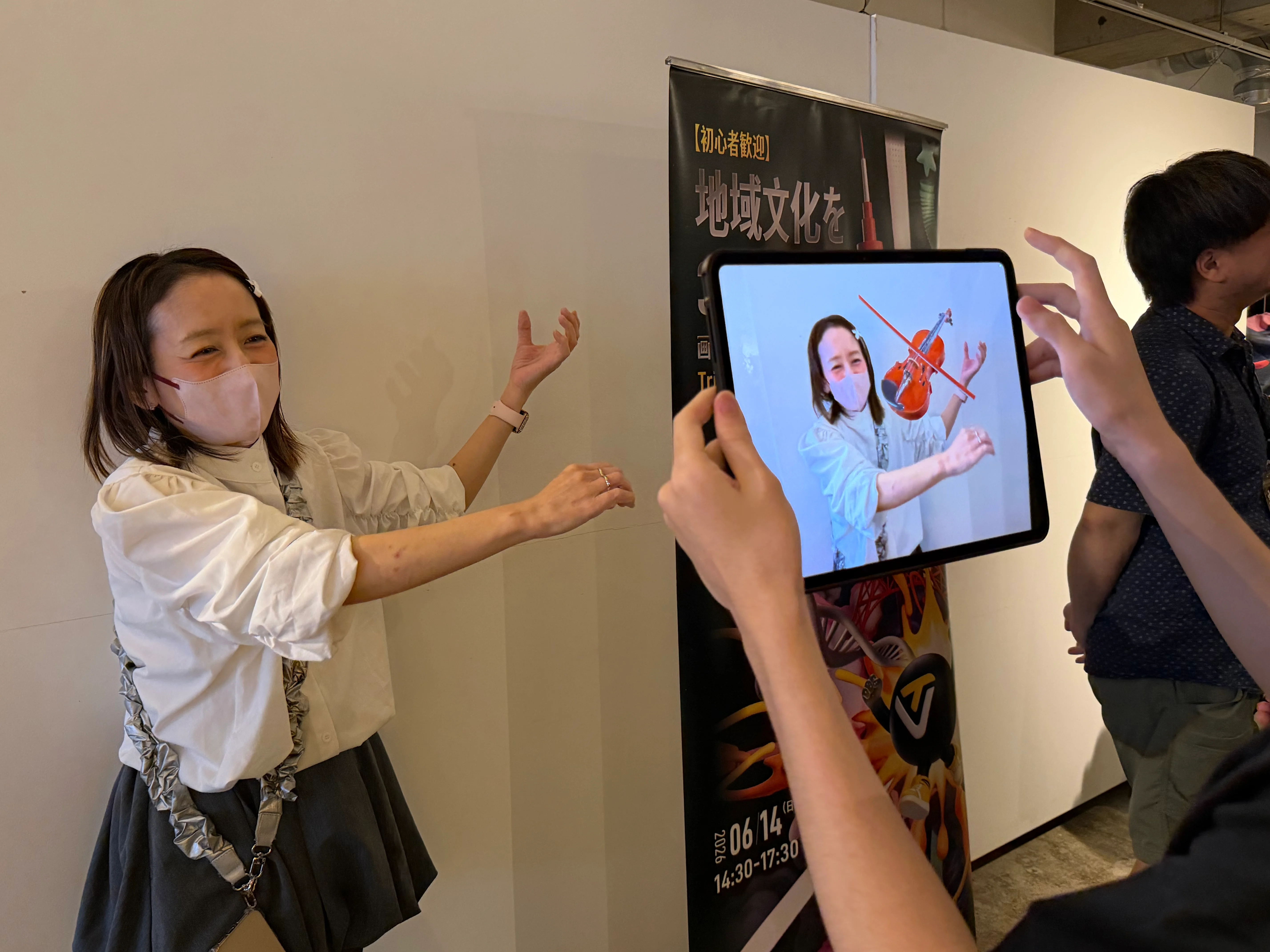
One high school student used Tripo to generate a violin model, brought the model into Blender to create movable elements, and then used AR to let his mother try “playing” the virtual violin.
The project connected AI generation, a traditional musical instrument, family interaction, and AR in a single experience, making it one of the most heartwarming presentations of the day.
An artist transformed an original album cover illustration into a 3D version, giving the previously two-dimensional artwork a new form that could be viewed from different angles, rotated, and placed within a physical environment.
Other participants transformed elements of traditional Japanese culture into spatial installations. One creator placed a structure resembling a black curtain within their tabletop environment, while another generated a three-dimensional horse sculpture with a mosaic-like visual texture.
A participant also brought several detailed objects that had previously been generated with Tripo and produced through 3D printing, demonstrating the complete path from a digital model to a physical creation.
Another participant arrived wearing a handmade zombie badge.
The zombie model had first been generated with Tripo, then 3D printed and painted by hand. The character, wearing a gas mask and creating graffiti, had a highly distinctive personal style.
The badge gave participants a clear example of how AI-powered 3D generation can become part of workflows for handmade products, toys, badges, collectible models, and independent creative merchandise.
During the final showcase, participants introduced their creations one by one.
Some greeted the audience enthusiastically, while others proudly presented their generated results. Each new creation was met with encouragement from the room, accompanied by repeated exclamations of “すごい,” meaning “amazing.”
For many participants, the workshop was both an introduction to new technology and a collective discovery of their own creative possibilities.
A Glimpse into the Energy of Japan’s Creator Community
To welcome participants, Tripo AI prepared a selection of customized gifts, including stainless steel bottles, 3D-printed luggage tags, 3D-printed tokens, and custom badges.
These objects extended Tripo’s 3D creative language into physical products and allowed participants to experience the connection between AI-generated 3D assets and real-world manufacturing from the moment they arrived.
Throughout the workshop, participants exchanged ideas about model quality, creative methods, and different ways of presenting their work through STYLY WebAR.
Some asked detailed questions about Tripo’s generation capabilities. Others shared their own experience in 3D printing, game development, video production, and art projects. Many participants discovered new ideas after seeing what others had created.
The group included several highly experienced creators. Some had contributed to character design for globally recognized game titles, some had produced videos with more than 1 million views, and others were long-term Tripo users who had already integrated AI 3D into their personal creative practices.
Bringing participants with such different backgrounds into the same workshop created a strong sense of energy and openness that reflected the character of Japan’s creator community.
This kind of naturally emerging community interaction is also one of the long-term goals of the Tripo AI Education Program.
Through accessible, hands-on workshops, Tripo hopes to bring teachers, students, artists, developers, and cultural partners together in a real-world environment where they can create something collectively.
A presentation, a generated model, or a participant showcase can become the starting point for future courses, creative challenges, campus events, and cultural projects.
A Four-Party Collaboration Connecting AI 3D, WebAR, Education, and Local Culture
The Tokyo workshop was hosted by Tripo AI, co-organized with STYLY WebAR and the Institute for Art Workshop Design Projects at Jissen Women’s University, with participation from Art Marketing Japan.
Each organization contributed a clear and complementary role to the project.
Tripo AI provided AI-powered 3D generation capabilities and educational ecosystem support. This allowed participants to begin with images, ideas, or handmade objects and quickly generate 3D assets for STYLY WebAR, exhibitions, 3D printing, and further creative production.
STYLY WebAR provided the pathway for displaying and experiencing those assets in physical environments. It allowed AI-generated 3D models to move beyond websites and devices into accessible AR experiences that could be viewed and shared within everyday spaces.
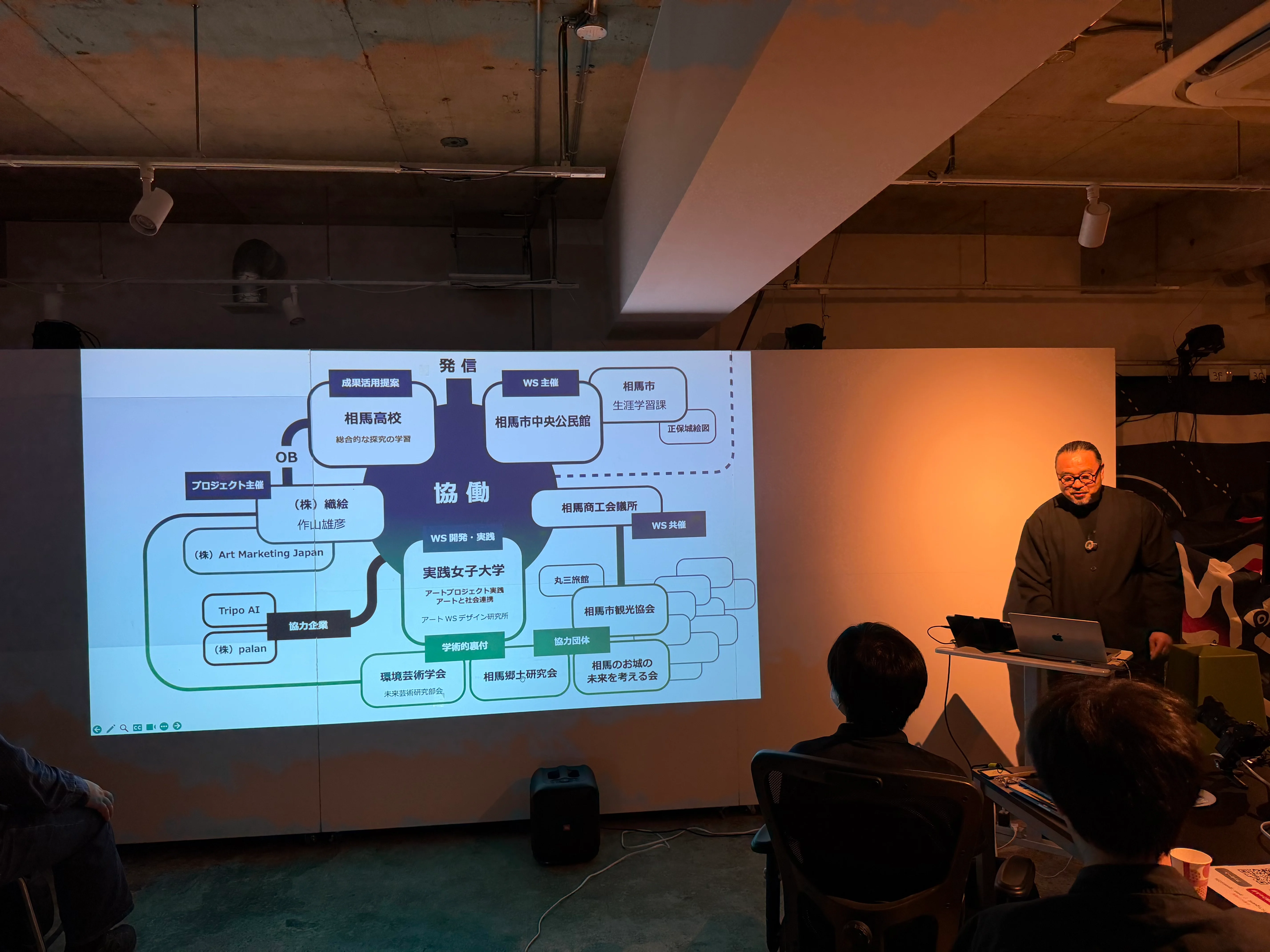
The Institute for Art Workshop Design Projects at Jissen Women’s University contributed educational design, cultural research, and project methodology. The institute transformed the historical resources and public learning environments of Soma into participatory workshop practices.
Art Marketing Japan connected local culture, community resources, and on-site project execution, helping the cultural project operate within its local context.
Through this collaborative structure, AI 3D, WebAR, local culture, and creator communities were brought together and tested within the same physical environment.
The technology was experienced through hands-on creation instead of remaining within a presentation. Local culture was explored through participation instead of relying solely on static interpretation.
By creating their own work and placing it into real-world space, participants gave the workshop a meaning that extended beyond a single product demonstration.
Looking Ahead: Fukushima, Campuses, and Online Virtual Exhibitions
From the theme of the “castle” in 2025 to the “gate” in 2026, the Fukushima Soma project continues to develop.
Tripo AI hopes to continue working with STYLY WebAR, the Institute for Art Workshop Design Projects at Jissen Women’s University, Art Marketing Japan, and additional local partners to support more cultural creation activities for children, students, and communities.
For an upcoming children’s craft project in Fukushima this August, the team is also exploring new possibilities.
Origami cranes or other creations made by children could potentially be transformed into online 3D models through the Tripo API and presented within a virtual exhibition.
Visitors could browse the works through a web browser and use STYLY WebAR to place selected models within their own physical environments.
This would allow local cultural projects to expand from physical venues into online spaces and reach audiences beyond Fukushima and Japan.
Children’s handmade creations, students’ interpretations, artists’ imaginations, and local history could all become visible, interactive, and open to further creation through AI-powered 3D generation and STYLY WebAR.
For Tripo AI, the Tokyo workshop represented an important on-site practice in Japan and the beginning of a longer-term collaboration.
Through the Tripo AI Education Program, Tripo will continue working with universities, creator communities, cultural institutions, and technology partners to make AI 3D a tool that connects creativity, education, cultural memory, and physical space.
From a single image to a 3D model, from a handmade object to an AR experience, and from a workshop in Shinjuku to the continued development of a local cultural project in Fukushima, Tripo AI and its partners are exploring new possibilities for AI-powered 3D creation across education and culture.