Master NPR Shading on AI 3D Models for 2D Lookdev
Professional Workflows for Stylized Shading on AI-Generated 3D Geometry
Translating rapid 3D generations into cohesive 2D aesthetics presents a distinct pipeline friction in media production. Without proper shading techniques, raw meshes clash with hand-drawn environments, causing severe visual inconsistencies. Implementing Non-Photorealistic Rendering (NPR) resolves this tension, allowing studios to maintain a unified, stylized look while significantly reducing production timelines.
Key Insights
- NPR workflows convert standard geometry into anime or comic-style assets, bypassing traditional modeling constraints and accelerating production.
- Clean base geometry and precise normal smoothing are critical for rendering sharp, artifact-free cel-shaded boundaries that mimic traditional ink.
- Replacing baked physical lighting with stepped color ramps establishes a convincing, dynamic hand-drawn appearance.
- Optimizing export data ensures necessary vertex normals transfer seamlessly into digital content creation (DCC) software for outline generation.
Introduction to NPR for AI-Generated Assets
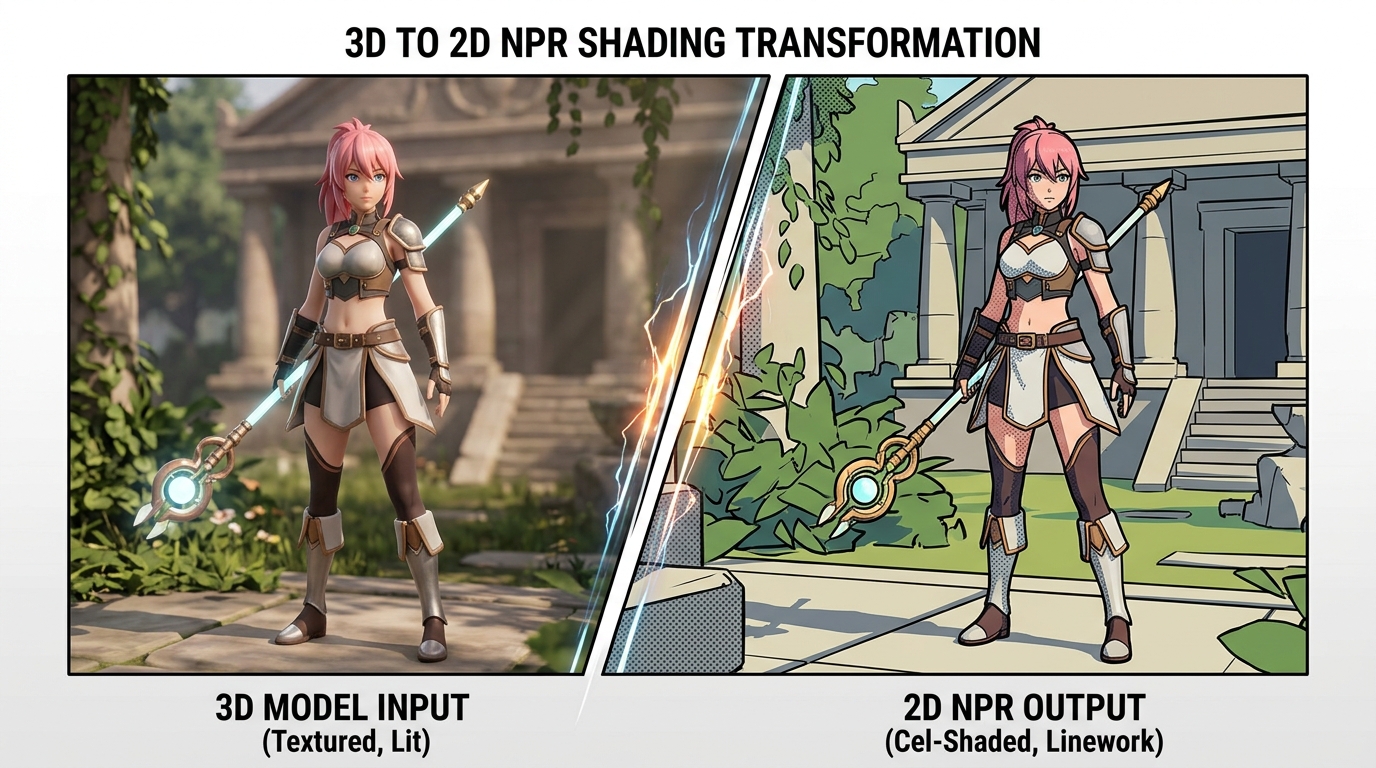
Non-Photorealistic Rendering (NPR) applied to AI-generated 3D models radically accelerates 2D-look animation lookdev. By transforming rapid Tripo AI generations into stylized assets, animation studios can maintain consistent anime or comic aesthetics while drastically reducing initial modeling and texturing time in production.
Bridging AI Generation and Stylized Art
The transition from conceptual illustration to usable production assets often relies on an image to 3D model pipeline to establish the foundational shapes. In professional lookdev, artists use image prompts alongside text for style transfer, providing visual examples of desired color palettes, textures, or compositions. Teams can control stylistic intensity by adjusting how strongly they reference particular styles or artists. For 3D applications, generated 2D images serve as style references for tools like Tripo AI to maintain visual consistency across 2D and 3D assets. This workflow ensures that the resulting geometry aligns with the director's vision before any shading occurs. However, standard generation defaults to a physical approximation. To bridge the gap to stylized art, the pipeline must strip away photorealism and replace it with mathematical shaders that emulate traditional media. The ultimate goal is to process these high-fidelity generations so they sit perfectly alongside hand-painted backgrounds without betraying their three-dimensional origins.
Why Base Geometry Matters for 2D Looks
NPR relies fundamentally on the underlying geometry to calculate contours and shadow borders. If a mesh sourced from an AI 3D model generator possesses uneven topology, toon shaders will produce erratic, noisy shadow terminators. The algorithms driving cel-shading calculate the angle between the light source and the surface normal. When topology is overly dense or features conflicting polygon flows, this calculation yields micro-shadows that destroy the illusion of flat, hand-painted art. Consequently, evaluating the base geometry is the mandatory first step in any stylized lookdev process. Smooth curves require adequate resolution without excessive vertex clutter, ensuring that the light vector mathematical checks result in clean, sweeping shadow lines reminiscent of traditional animation cels. Technical directors often enforce strict geometric standards, as a flawed base mesh will exponentially increase the time spent attempting to fix shading errors in the compositing phase.
Preparing Tripo Models for Stylized Shading
Successful NPR lookdev requires clean base geometry and proper data transfer. Artists must seamlessly export models from Tripo AI using industry-standard formats like FBX, OBJ, or GLB, and optimize vertex normals in their DCC software to ensure sharp, artifact-free cel-shaded boundaries .
Choosing the Right Export Format (FBX, OBJ, GLB)
When integrating software for professional lookdev, selecting the appropriate file type dictates how well vertex data survives the transfer. The supported formats include USD, FBX, OBJ, STL, GLB, and 3MF. For NPR pipelines, FBX and OBJ are highly recommended due to their robust handling of custom vertex normals and hard edge data. Before exporting, teams often utilize the Tripo AI FBX viewer, which supports animation playback, complex mesh rendering, real-time shading, rigging visualization, and camera views. This allows technical artists to verify the structural integrity of the asset and anticipate how the geometry will deform under animation. Reviewing rigging visualization early ensures that the toon shader will react predictably to joint movements without causing shadow tearing or broken outlines during final rendering.
Retopology and Normal Smoothing Basics
Once imported into a primary DCC software, the raw mesh frequently requires normal optimization. Cel-shaded materials expose every flaw in vertex smoothing. If a model features sharp angles where a smooth curve is intended, the toon shader will draw a harsh, jagged shadow line across the boundary. Technical artists address this by editing the smoothing groups or custom split normals. In many cases, applying a data transfer modifier to project the normals of a perfectly smooth proxy object onto the detailed mesh resolves these shading errors seamlessly. For highly complex assets, a quick automated retopology pass may be necessary to align the edge flow with the intended deformation and shading lines. Proper normal alignment guarantees that the stepped color ramps behave predictably under dynamic lighting, simulating the deliberate, confident strokes of a 2D animator.
Core Lookdev Techniques for 2D-Look Animation
Achieving a convincing 2D-look involves replacing traditional physical lighting with stepped color ramps and creating stylized outlines. Using DCC software, artists can apply custom toon shaders to Tripo meshes and utilize the inverted hull method for dynamic, hand-drawn style ink lines.
Building a Stepped Toon Shader
The foundation of any NPR pipeline is the stepped toon shader. Unlike Physically Based Rendering (PBR) which calculates soft gradients of light falloff, a toon shader forces the lighting calculation into discrete bands. Artists achieve this by taking the dot product of the surface normal and the incoming light vector, which outputs a continuous value between zero and one. This value is then routed through a constant interpolation color ramp. By placing color stops at specific thresholds, the soft gradient snaps into the hard, distinct shadow bands characteristic of anime and comic book illustrations. This mathematical approach guarantees that the model responds dynamically to scene lighting while maintaining a strictly two-dimensional appearance. Furthermore, separating ambient light calculations from direct light ensures that the shadows never fall into pure black unless stylistically intended, preserving the vibrant, saturated look of traditional animation.
Implementing Inverted Hull Outlines
Stylized assets require distinct outlines to separate them from the background, simulating ink or pencil strokes. The industry standard for real-time and rendered applications is the inverted hull technique. This involves duplicating the base mesh, pushing the vertices outward slightly along their normals, and flipping the face orientation inside out. A flat, unlit black material is then applied to this duplicate shell. Because the faces are inverted, the camera only renders the backfaces that protrude past the original model's silhouette, creating a perfect, uniform outline. The thickness of this outline can be controlled dynamically by adjusting the offset distance. For advanced lookdev, vertex weight painting can be used to thin the line art in specific areas, such as delicate facial features or sharp tapering hair tips, to mimic pressure-sensitive brush strokes from a traditional artist.
Managing Flat Colors and Albedo Maps
Surface coloration in NPR workflows demands a minimalist approach. While standard AI texturing often produces photorealistic details, micro-textures, and baked ambient occlusion, these elements actively fight against the 2D aesthetic. Toon shading requires flat, unshaded base colors (albedo) to serve as the canvas for the stepped lighting ramps. Artists must simplify the generated textures, utilizing image processing to blur out high-frequency noise and remove baked highlights. In many cases, discarding the complex texture entirely in favor of assigning flat color materials to specific polygon faces yields a more authentic anime aesthetic. The texture map should only contain local color information, leaving all ambient occlusion, highlights, and core shadows entirely up to the dynamic toon shader calculations.
Fixing Common AI Mesh Shading Artifacts
AI models often present unique challenges for NPR workflows, such as baked-in lighting or highly dense UV islands. Resolving these issues involves discarding photorealistic textures, overriding materials with flat emission nodes, and manually defining sharp edge creases for cleaner stylized shadow transitions.
Removing Baked Lighting from Textures
One of the most frequent hurdles in adapting generated assets for 2D lookdev is the presence of baked lighting within the diffuse texture. When an asset already contains painted-in shadows and highlights, the dynamic toon shader will multiply its own shadow bands over the existing baked shadows, creating a muddy, conflicting visual. Technical artists resolve this by processing the textures through a frequency separation filter or using node-based math in the DCC to clamp the texture's value range. Ideally, the texture is flattened into pure base colors. If the baked lighting is too severe, artists will utilize the generated UV map to quickly block out new, solid-color texture maps, ensuring the toon shader operates on a clean slate. This guarantees that the asset reacts purely to the designated light sources in the scene.
Controlling Shadow Terminators on Dense Meshes
High-density meshes frequently suffer from shadow terminator artifacts—a phenomenon where the boundary between light and shadow appears jagged or pixelated instead of smooth. This occurs because the stepped color ramp lacks the soft interpolation needed to hide the individual polygons along the curvature of the generated topology. To fix this, artists can implement a shadow terminator offset within the render engine, which mathematically pushes the shadow line slightly toward the light source, smoothing the transition over dense geometry. Alternatively, adding a fractional blur to the lighting calculation immediately before it enters the color ramp can soften the jagged edges without losing the distinct cel-shaded look. Proper normal smoothing, as established during the preparation phase, remains the primary defense against this artifact, but these rendering adjustments provide a necessary safety net for complex geometry.
FAQ
1. How do I fix jagged shadow edges on Tripo AI models when cel-shading?
A: Smoothing vertex normals and adjusting the shadow terminator offset in the DCC software resolves jaggedness. Jagged edges occur when the toon shader's hard threshold interacts with dense or unsmoothed geometry. By recalculating the custom split normals or applying a normal transfer modifier, the surface data is smoothed. Additionally, increasing the shadow terminator offset in the render settings pushes the shadow calculation past the problematic geometry, resulting in a clean, sharp line characteristic of traditional animation.
2. Should I use the default Tripo textures for 2D anime lookdev?
A: It is highly recommended to ignore baked lighting textures and instead use flat color nodes or heavily simplified albedo maps. Default textures often contain photorealistic ambient occlusion and directional lighting that conflict with dynamic toon shaders. For a genuine 2D look, the base material must be completely flat, allowing the stepped color ramps and real-time scene lights to dictate all shading and highlights without interference from pre-calculated texture data.
3. Which export format retains the best data for NPR outlines?
A: FBX or OBJ formats are the most reliable choices to ensure hard edges and vertex normals transfer perfectly for inverted hull outlines. The inverted hull technique relies entirely on accurate vertex normal direction to push the duplicate mesh outward evenly. These formats preserve the explicit normal data established during generation, preventing the stylized ink lines from breaking, pinching, or rendering with inconsistent thickness in the final lookdev output.