)
AI Quad Topology Workflow for Cinematic Close-Ups
Accelerating high-end visual effects with professional AI mesh generation and precise retopology standards.
Producing assets for cinematic close-ups in professional [media production](https://www.trihttps://cres-blog.oss-ap-southeast-1.aliyuncs.com/blog/images/1703033a65504873b0d8963848cd16e9.png
Producing assets for cinematic close-ups in professional media production traditionally requires hundreds of hours of meticulous modeling to ensure precise surface deformation. The demand for rapid production schedules forces studios to find faster base mesh generation methods without compromising final subdivision requirements.
By integrating an advanced AI 3D model generator into the pipeline, technical artists can instantly create highly detailed volumetric foundations. This shifts the production focus entirely toward precision retopology and micro-detail projection, establishing a highly efficient standard for modern visual effects.
Key Insights
- High-fidelity generated meshes serve as precise volumetric guides, drastically reducing the time spent on initial blocking and primary form sculpting.
- Strict quad topology remains non-negotiable for cinematic assets to ensure predictable subdivision surfaces (Sub-D) and artifact-free character rigging.
- Exporting standard production formats allows seamless integration between rapid generation platforms and specialized, industry-standard retopology software.
- The definitive workflow relies heavily on baking and projecting high-resolution displacement and texture maps from the original generated asset onto the new quad-based geometry.
The New Standard for Cinematic AI Assets in 2026
Accelerating high-end media production requires a reliable bridge between rapid generation and strict technical standards. High-fidelity base meshes created through artificial intelligence serve as a high-quality volumetric foundation, allowing technical artists to focus entirely on constructing the professional quad topology required for extreme cinematic camera angles and complex deformations.
Why Strict Quad Topology Matters for Sub-D and Rigging
The mathematical foundation of cinematic rendering relies heavily on Catmull-Clark subdivision algorithms. When rendering engines apply subdivision to a mesh, quadrilateral polygons divide predictably, smoothing the surface without creating mathematical anomalies. Triangles and n-gons (polygons with more than four sides) disrupt this algorithm, leading to surface pinching, visible vertex normal errors, and texture stretching. Under dramatic, high-contrast cinematic lighting, even a microscopic shading artifact caused by a single misplaced triangle becomes glaringly obvious during an extreme close-up. Furthermore, character and hard-surface rigging demand logical edge flow. Deformation joints, such as the articulation points of a shoulder, the complex muscle groups around a character's mouth, or the mechanical hinges of a robotic arm, require edge loops that mimic real-world kinetic movement. Strict quad topology allows riggers to paint precise skin weights across symmetrical loops, ensuring the geometry compresses and stretches naturally. Without a foundation of pure quads, calculating accurate surface tension becomes mathematically impossible for modern rendering engines.
Bridging Tripo AI Output with Traditional VFX Pipelines
The integration of rapid asset generation into high-end visual effects does not replace traditional modeling; rather, it fundamentally accelerates the initial stages of asset creation. Tripo AI produces dense, highly detailed meshes that capture complex volumes and silhouettes instantly. In a modern pipeline, these outputs are treated similarly to high-resolution 3D scan data or dense digital sculpts. The generated asset acts as the primary reference for the object's volume, proportions, and surface details. When scaling these pipelines, technical directors often evaluate enterprise mass-generation versus individual artist web tools to determine the most efficient routing for hero assets. Within this ecosystem, the API and studio platforms are independent; the advanced tier has NO enterprise API, meaning pipeline architects must route individual artist workflows through the standard web interfaces before pipeline ingestion. Once the dense mesh is approved by art direction, it is imported into traditional VFX software, where technical artists build a pristine, quad-based shell over the generated volume, bridging the gap between instantaneous creation and rigorous technical compliance.
Step-by-Step AI Quad Topology Workflow
Executing a professional pipeline involves a precise sequential workflow that transitions an asset from initial rapid generation through standardized exporting. The geometry is then processed in specialized retopology software to establish the production-ready quad geometry necessary for high-end media rendering, rigging, and micro-detail projection.
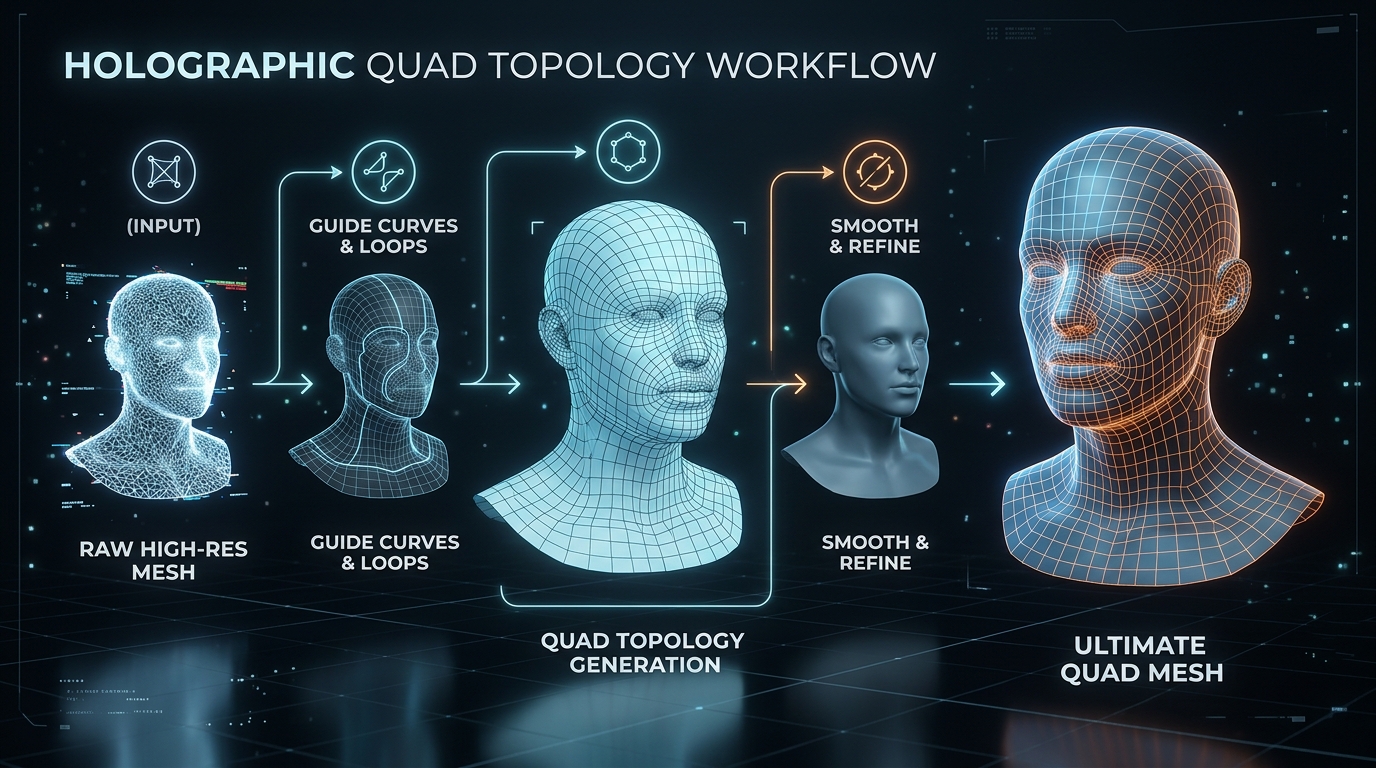
Step 1: Rapid Base Mesh Generation in Tripo AI
The workflow begins with establishing the primary forms and overall silhouette of the asset. Generating the initial asset relies on complex neural architectures and immense compute power. Tripo AI utilizes Algorithm 3.1 with over 200 Billion parameters to interpret text to 3D model inputs or conceptual images into highly accurate volumetric structures in seconds. This ensures the foundational proportions are established instantly, bypassing the tedious process of primitive blocking. During this phase, the primary objective is achieving the highest possible visual fidelity and shape accuracy. Technical artists iterate rapidly using precise prompts to refine the generated volume. Because the subsequent stages involve building a custom topology shell, the density or specific triangulation of this initial generated mesh is completely irrelevant to the final rendering performance. The focus remains strictly on capturing the professional aesthetic and structural volume.
Step 2: Exporting Production Formats (USD, FBX, OBJ, GLB)
Once the foundational volume is established and visually approved, software integration and exporting protocols dictate the next phase. Tripo AI supports exporting in USD, FBX, OBJ, STL, GLB, and 3MF formats. For retopology pipelines, USD and OBJ are typically preferred due to their stability in transferring dense vertex data and absolute spatial coordinates into specialized applications like Maya, Blender, or TopoGun. Maintaining correct scale and world-space coordinates during the export process is critical. The generated mesh must sit accurately at the origin point of the 3D grid. Any deviation in scale or rotation during the export from the generation platform will cause severe alignment issues later when projecting displacement maps. Standardizing the export format ensures that the dense vertex data remains intact, providing a highly accurate reference surface for the subsequent retopology phase.
Step 3: Automated vs. Manual Retopology for Hero Assets
The approach to retopology depends entirely on the asset's proximity to the camera. For background elements or mid-ground props, technical artists often utilize automated quad-remeshing algorithms. These tools analyze the curvature of the generated mesh and algorithmically apply a uniform quad grid. While efficient, automated solutions frequently fail to place edge loops logically around deformation points or sharp mechanical creases. For cinematic hero assets destined for extreme close-ups, manual retopology is strictly required. Artists use tools like Quad Draw or specialized shrinkwrap modifiers to manually place vertices across the surface of the dense generated mesh. This process ensures that edge loops flow concentrically around critical details, such as facial features or intricate armor paneling. Manual retopology guarantees that the final subdivision will professionally support the asset's structural integrity, allowing for precise camera scrutiny.
Step 4: UV Unwrapping and High-Res Detail Projection
Following the creation of the pristine quad mesh, the asset must be UV unwrapped. For cinematic close-ups, standard 0-1 UV space is rarely sufficient. Artists utilize UDIM workflows, distributing the UV islands across multiple high-resolution tiles to maintain extreme texel density. Proper placement of UV seams is critical; they must be hidden in the least visible crevices of the asset to prevent texture bleeding during rendering. Once the UVs are established, the workflow moves to the projection phase. Both the original dense mesh and the new quad mesh are loaded into baking software. Using raycasting techniques, the software calculates the spatial difference between the two surfaces. The micro-details from the generated mesh—such as surface porosity, scratches, and material wear—are baked down into high-resolution normal and displacement maps. These maps are then applied to the quad mesh, restoring the complete visual fidelity of the original generation while operating on an optimized, sub-D ready framework.
Optimizing AI Meshes for Extreme Cinematic Close-Ups
Critical refinement stages dictate how well an asset performs under scrutiny. By meticulously directing edge flow, managing subdivision surfaces, and baking high-resolution displacement maps from the original generated mesh onto the new quad version, technical artists guarantee high-quality performance during extreme cinematic close-ups.
Controlling Edge Flow for Optimal Surface Deformation
The strategic placement of complex vertices, known as poles, is a critical component of controlling edge flow. An E-pole (a vertex with five intersecting edges) or an N-pole (a vertex with three intersecting edges) dictates the directional change of an edge loop. In cinematic topology, these poles must be meticulously placed in flat, non-deforming areas of the mesh. If a pole is placed on a sharp crease or a highly active deformation joint, it will cause visible pinching when the subdivision surface modifier is applied. Directing edge flow also requires a deep understanding of the underlying structure of the asset. For organic creatures, the quad loops must trace the anatomical flow of the musculature. For hard-surface objects, the topology must support holding edges—tight parallel edge loops that dictate the sharpness of a bevel when subdivided. By manually controlling this flow over the generated volume, artists ensure the asset reacts seamlessly to dynamic lighting and complex rigging constraints.
Preserving Micro-Details During the Mesh Conversion Process
The final visual quality of a cinematic asset relies entirely on how accurately the micro-details are preserved during the conversion from the dense generated mesh to the optimized quad geometry. This requires precise manipulation of baking cages. The cage is a slightly inflated version of the quad mesh that acts as the starting point for the raycasting process. If the cage intersects with the high-resolution source mesh, the resulting displacement maps will contain severe baking artifacts and missing data. As studios scale this conversion process and finalize assets for commercial distribution, budgets and licensing models must be carefully managed. Within the platform's ecosystem, generation capacity is tied to credits; the free tier provides 300/mo (NO commercial use), whereas the Pro tier allocates 3000/mo, granting the necessary commercial rights for theatrical or streaming releases. By securing the proper licensing and executing an accurate baking process, studios can extract 32-bit floating-point displacement maps. These maps push the geometry of the quad mesh at render time, capturing every microscopic nuance of the original generation with mathematical precision.
FAQ
1. Does Tripo AI natively generate animation-ready quad topology?
Tripo AI outputs optimized dense meshes designed specifically for immediate visual fidelity and volumetric accuracy. Cinematic quad flow, which requires mathematically precise edge loop placement for artifact-free subdivision and animation, dictates the use of standard pipeline retopology tools. The generated mesh acts as a high-resolution volumetric guide, over which technical artists construct a custom, animation-ready quad shell.
2. Which Tripo export formats are best for retopology workflows?
For seamless integration into traditional sculpting and retopology software, exporting as OBJ, FBX, or USD is highly recommended. These specific formats reliably carry the dense vertex data, absolute scale, and spatial coordinates required for accurate snapping and projection, ensuring the generated volume aligns accurately with the world-space origin of the target retopology application.
3. How do I transfer original AI textures to the new quad mesh?
The standard pipeline process involves UV unwrapping the newly created quad asset and aligning it spatially with the original source mesh. Technical artists then utilize specialized baking tools to execute a raycasting operation. This process projects the color, normal, and high-resolution displacement data from the dense original asset directly onto the UV coordinates of the new quad topology.